
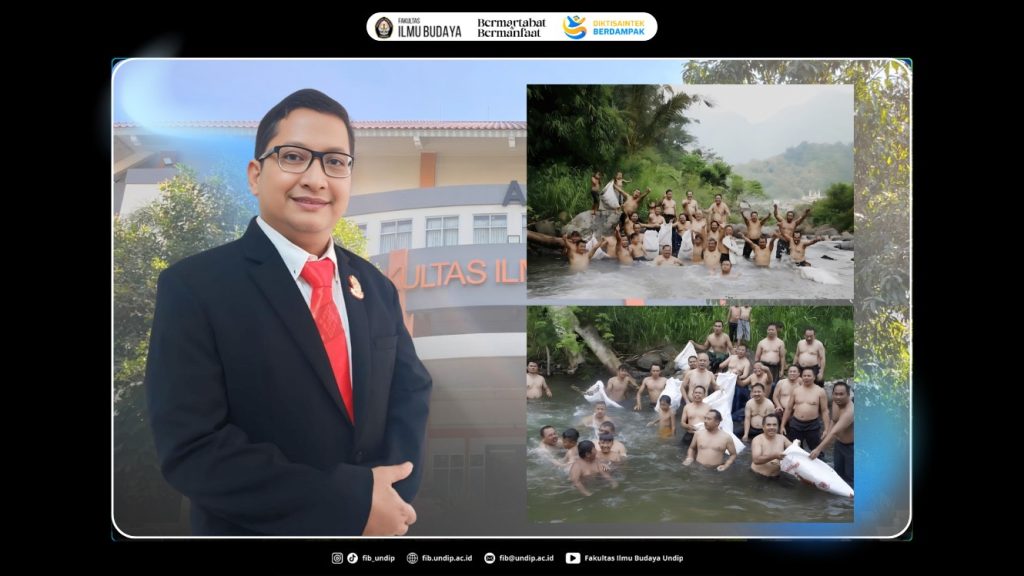
FIB UNDIP – The local tradition of the Javanese coastal community often holds a depth of meaning that goes beyond just a ceremony. Research from the Dean of the Faculty of Cultural Studies Diponegoro University (FIB UNDIP), Prof. Dr. Alamsyah, M.Hum., together with Vicky Verry Angga, dissected how the Padusan tradition before the month of Ramadan in Tempur Village, Jepara Regency, became a real evidence of cultural acculturation, spiritual purification, as well as an effort to preserve the environment.
The research was published in the international proceedings indexed by BIO Web of Conferences(2025) entitled “Padusan Tradition: Environmental Preservation Efforts and Self-Approach to God”. https://www.bio-conferences.org/articles/bioconf/pdf/2025/47/bioconf_smils2025_04011.pdf
Exploring the Depth of the Meaning of Padusan Tradition on the Java Coast
In the historical- Qualitative study, Prof. Alamsyah commented that the people on the north coast of Java have adaptive characteristics towards Islamic values. The Padusan tradition comes from the Javanese word adus which means bathing is not just an activity to clean the body before Ramadan in the month of Ruwah.
At the spiritual level, Padusan is interpreted as an effort to thaharah or purify oneself from hadas and impurity, both outwardly and internally, so that it is ready to welcome the sanctity of Ramadan. From a medical and psychological point of view, the ritual of soaking or bathing in this flowing water source also functions as a form of natural hydrotherapy that can relieve stress, increase blood circulation, and maintain physical balance.
Tempur Village: Harmony of the River, Humans, and the Creator
The focus of this research highlights the implementation of Padusan in Tempur Village, Keling District, Jepara, a village nicknamed “hidden village” on the slopes of Mount Muria surrounded by beautiful natural scenery. Villagers used to carry out the tradition of bathing together in the clear and natural Tempur River.
Through this tradition, residents not only meet each other and forgive each other before fasting, but also cultivate collective awareness to maintain the cleanliness and preservation of the river. The river is seen as a source of life that must be taken care of. Islam itself teaches that the harmony of human relationships includes four aspects: the relationship with God, fellow human beings, oneself, and the surrounding environment.
Academic Contribution for the Preservation of Nusantara Culture
Through a moderate Islamic approach that is tolerant of local cultural heritage, this research shows how the values of tawhid and hygiene teachings can fill and strengthen ancestral traditions without having to erode their local wisdom.
The scientific publication by the leader of FIB UNDIP also confirms the commitment of the Cultural Campus in mapping, caring for, and promoting the local wisdom of the archipelago to the international academic stage.