
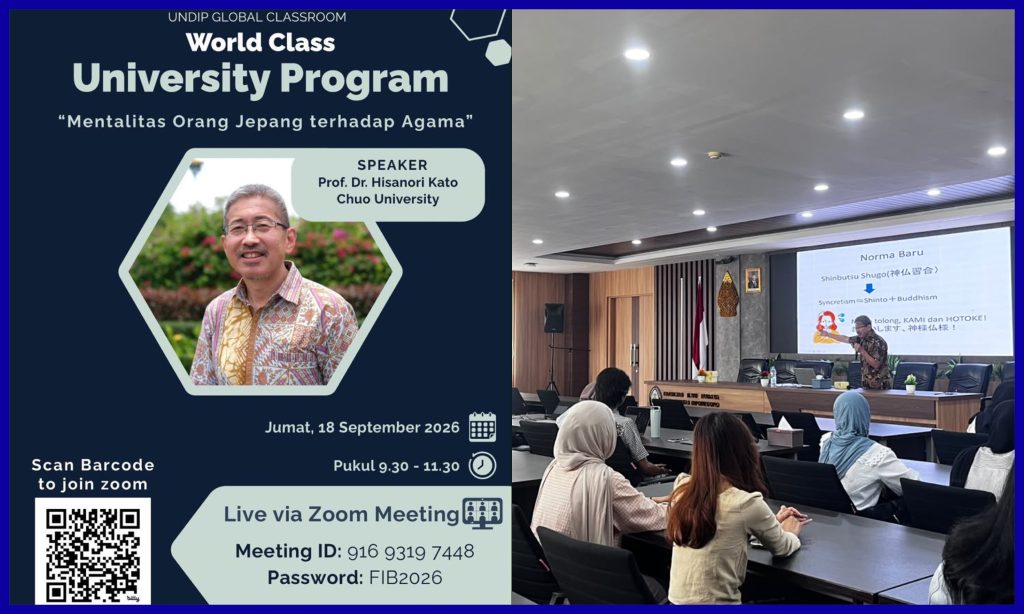
FIB UNDIP – If you pay attention to the lives of Japanese people, there is one thing that is quite unique, which is that they diligently come to the temple during festivals or weddings, but almost never discuss matters of faith in daily life.
This interesting phenomenon was thoroughly discussed in the public lecture of Undip Global Classroom (UGC) held by the S-1 Study Program in Japanese Language and Culture FIB Undip, Friday (9/18/2026).
The event that took place in a hybrid manner in the Seminar Room of the D FIB Undip Building and the Zoom Meeting invited a religious sociology expert from Chuo University, Prof. Dr. Hisanori Kato The course of the discussion was guided by FIB Undip lecturer, Nisia Nur Dwi Agusta, S.Hum., M.Si., and listened to by students of the fifth and seventh semester of Culture.
Not a Rigid Rule, But Part of Tradition
Through the topic “Japanese Mentality towards Religion”, Prof. Kato said that the people of the Land of Sakura generally do not see religion as a set of rigid dogmatic rules.
For the residents there, religious practices are more integrated with living habits and how to maintain environmental harmony. Therefore, it is natural that someone can participate in Shinto rituals while celebrating Buddhist traditions. Moments such as seasonal festivals to wedding ceremonies are lived as part of community culture, not solely a religious obligation.
Why Are Japanese People Careful When Talking About Religion?
Even though they are relaxed in carrying out their traditions, Japanese people are quite careful if they have offended formal religious institutions or organizations. This reason is also what makes the matter of trust strictly separated from the public domain, such as in schools and government agencies.
Prof. Kato said, this separation has its own impact. Most citizens are less used to understanding how important the meaning of faith is for others. The impact, when dealing with citizens from other countries who are obedient to their religious teachings, it is not uncommon to feel awkward or open.
Therefore, at the end of his presentation, Prof. Kato invites the participants to continue to hone their mutual understanding and be willing to learn to understand cultural differences from other nations.
This public lecture was closed with an interactive discussion. Students who were present took advantage of this moment to ask directly about various social phenomena that are happening in Japan right now.