
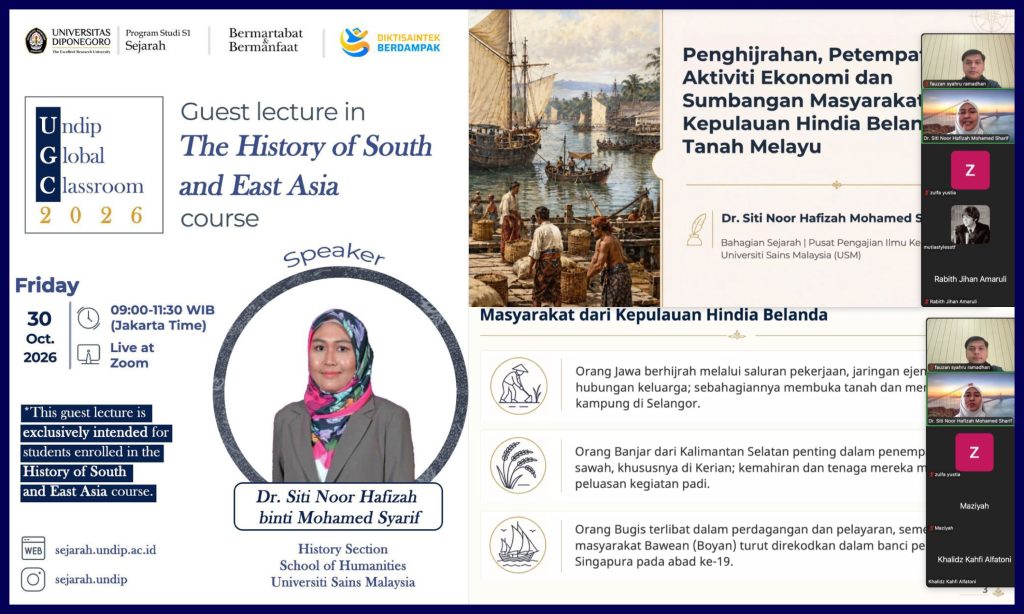
FIB UNDIP – The S1 History Study Program of the Faculty of Humanities, Diponegoro University (FIB Undip) once again presents international insights through the Undip Global Classroom (UGC) 2026 agenda.
The online lecum that was broadcast via Zoom on Friday (10/30/2026) presents Dr. Siti Noor Hafizah Mohamed Sharif from the Humanities Study Center, Universiti Sains Malaysia (USM).
Attended by students of the History of South Asia and Southeast Asia course, this session dissected the topic entitled “Emigration, Placement, Economic Activities and Community Donation from the Dutch East Indies Islands in the Malay Land”.
Traces of Nusantara Residents: Land Clearing to Commercial Ports
In his presentation, Dr. Siti Noor Hafizah commented on how the wave of population displacement of the archipelago to the Malay Peninsula had taken root long before the 19th century.
Trade routes, shipping, and kinship became the main bridge for the movement of residents from the Dutch East Indies Islands to important ports such as Singapore, Pinang Island, Melaka, Klang, and Anson Bay.
This movement had a major impact on the establishment of the local social order:
Javanese people: Played a big role in opening coconut and coffee farming in Selangor (Kuala Langat, Klang, and Kuala Selangor), developed from plantation workers to independent land workers.
Banjar People: Bringing expertise in cultivating rice paddy fields in Kerian, Perak.
Bugis & Mandailing Community: Active in the inter-port trade shipping network, as well as the involvement of Sutan Puasa figures from Mandailing in the early history of regional opening, trade, and tin mines in Kuala Lumpur.
Critically Reading Colonial Census Data
In addition to tracing the physical traces of the settlement, Dr. Siti Noor Hafizah reminded the importance of reading the census data of the colonial era population carefully. According to him, official statistical figures often have limitations in recording and changes in population categories in each period.
Therefore, understanding the historical dynamics of migration needs to combine numerical data with the context of land policy, economic opportunities, and social interaction of residents in the destination area.
Strengthen the Regional Historical Perspective
The implementation of Undip Global Classroom emphasizes the commitment of the S1 History of FIB Undip in expanding the thinking treasure of its students.
Through this cross-country discussion, participants are invited to see that the movement of Nusantara residents in the past was not just a geographical shift, but an important foundation that formed the economic landscape, settlement, and social structure of Southeast Asia to this day.