
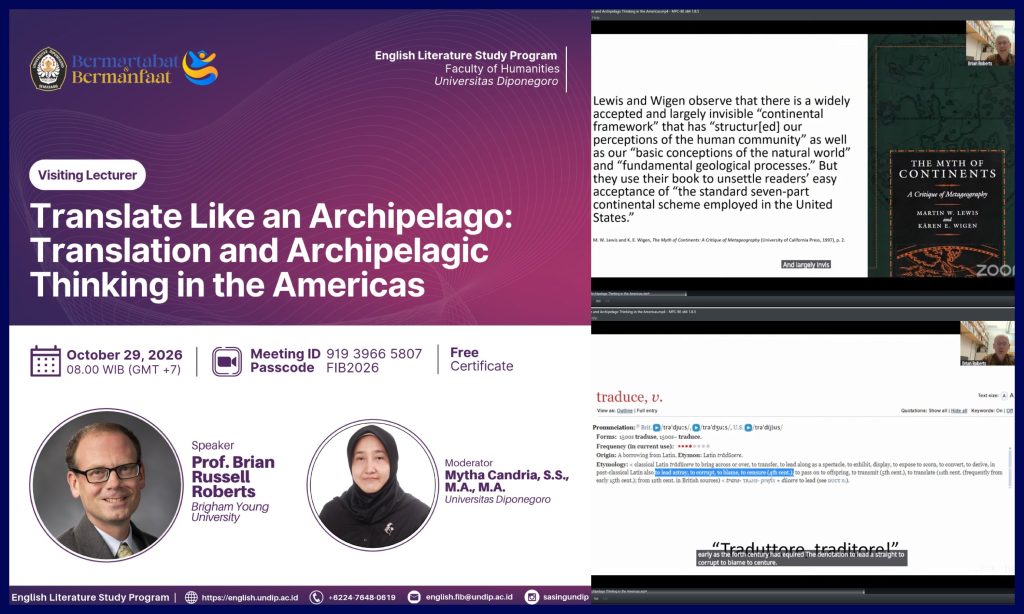
FIB UNDIP – The English Literature Study Program of the Faculty of Humanities, Diponegoro University (FIB Undip) once again presents an international academic discussion room through the Visiting Lecturer title.
The guest lecture that takes place online through Zoom Meeting on Thursday (10/29/2026) starting at 08.00 Western Indonesia Time presents Prof. Brian Russell Roberts from Brigham Young University, United States, as the main speaker.
This open event for the academic community is hosted directly by the English Literature lecturer FIB Undip, Mytha Candria, S.S., M.A., M.A., as moderators.
Rereading the Concept of Continents Through the Thought of Islands
Carrying the theme titled “Translate Like an Archipelago: Translation and Archipelagic Thinking in the Americas”, Prof. Brian Russell Roberts invites participants to come out of the geographical view that has been too centered on a large land or continental framework (continental framework).
Referring to the thoughts of Lewis and Wigen in The Myth of Continents, he dissected how the concept of dividing the seven continents often limits the way humans view the relationship between societies and cultures.
Through the approach of archipelago thinking (archipelagic thinking), the translation process is no longer seen as just moving words from one language to another which is often stuck in the old notion of “Traduttore, traditore!” (The translator is a traitor) but as a bridge of fluid and interconnected cultural dialogue.
Discussion and Expansion of Cross-Cultural Insight
This virtual guest lecture session was enthusiastically attended by the students and participants who were present in the Zoom room. Under the guidance of Mytha Candria, the discussion was dynamic with various responses and critical questions about the study of translation and American studies.
Through the presence of this professor from the United States, the FIB Undip English Literature Study Program continues to strive to enrich the research perspective of its students, as well as familiarize the residents of the Culture Campus to see language and literature issues from a broader global perspective.