
FIB UNDIP – Students of the Faculty of Humanities of Diponegoro University (FIB UNDIP) once again showed their real contribution to the development of character and public literacy.
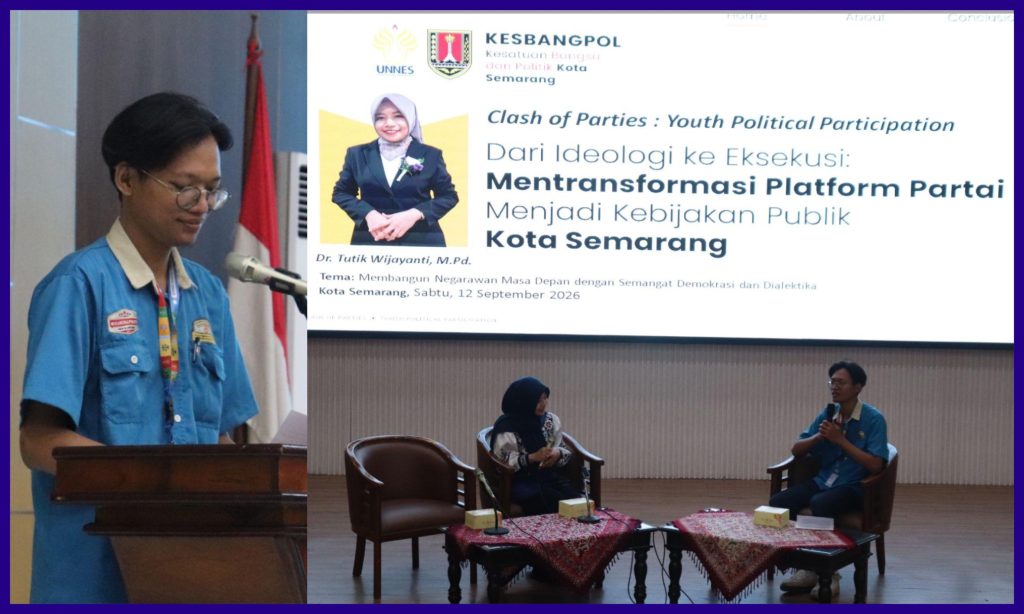
Moch. Latif, a student of the Social Anthropology study program class of 2024 who currently serves as the Executive Director of InterAksi Semarang, successfully led the implementation of an interactive political education activity entitled “Clash of Parties: Youth Political Participation” at the Semarang City Hall in 2026.
The activity held through strategic cooperation between the youth community startup InterAksi Semarang and the Semarang City Government (Bakesbangpol) carries the theme “Building Future Statesmen with the Spirit of Democracy and Dialectics”.
This event facilitated 150 participants from students from all over Semarang City to study the dynamics of political parties, public policy analysis, and the design of a work program that is inclusive and gender responsive.
Series of Innovative Programs and Contribution Traces of FIB UNDIP
The Clash of Parties event is the 3rd big program that was successfully carried out by InterAksi Chapter Semarang under the leadership of Moch. Lative.
Previously, InterAksi Semarang has successfully held two strategic programs that also involve the active role of FIB UNDIP academics and alumni:
1. The First Program (Youth Parliamentary Semarang): Presenting the Social Anthropology lecturer of FIB UNDIP, Eko Rahmanto, S.Hum., M.Si., and the Vice Chairman of the Semarang City DPRD, Suharsono, S.S., M.Si. (who are FIB UNDIP alumni), as the main speakers in dissecting the role of the parliament and the political representation of youth.
2. Second Program (Unlocked Museum): Cultural political learning innovation that invites young people to learn and discuss about political dynamics through the analysis of historical and cultural artifacts at the Ranggawarsita Museum Semarang.
3. Third Program (Clash of Parties): Simulation of party formation, formulation of 6P ideology, coalition building, to gender-responsive political party platform debate in the Semarang City Hall.
Application of Social Anthropology in the Reality of Democracy
As a student of Social Anthropology FIB UNDIP, Moch. Latif combines the socio-cultural science that he studied in college with real action in society.
Moch. Latif emphasized that access to higher education is a social capital that must be returned to the wider community.
“Politics is present and felt by everyone in daily life. Therefore, it has become our moral responsibility, as people who have access to education to educate politics widely and openly,” said Moch. Latif on the sidelines of activities.
“Through InterAksi, we are here for colleagues who want to learn politics in theory or direct practice through simulation. We want to prove that social and political science can be studied in an interactive, critical, and fun way without being trapped in disinformation,” he added.
Cross Sector Collaboration
In the implementation of Clash of Parties, InterAksi Semarang acts as a substance designer and event executor.
Meanwhile, the Semarang City Government supports the utilization of the City Hall facilities and presents academic speakers from the State University of Semarang, Tutik Wijayanti, M.Pd., and members of Commission D of the Semarang City DPRD, Siti Roika, S.Pd.
The success of this series of programs proves the active role of FIB UNDIP students and alumni in producing critical, inclusive, and integrity youth leadership.
About InterAksi
InterAksi is a youth community startup that engages in political education in a fun, interactive, and earthy way.
As a non-governmental (NGO) and non-partisan organization, InterAksi Semarang contains the collaboration of students and students across campuses and schools in Semarang City that focuses on strengthening political literacy, gender equality advocacy, public policy analysis, and the development of democratic and inclusive future leadership.
● Vision: Creating social justice with political understanding to the community.
● Mission:
1. Creating a political education program with a more grounded approach.
2. Making the young generation as a pioneer in creating a just democracy.
3. Changing the political connotation from something dark to light.
(This article was written by Moch. Latif, a student of the Social Anthropology study program class of 2024)