
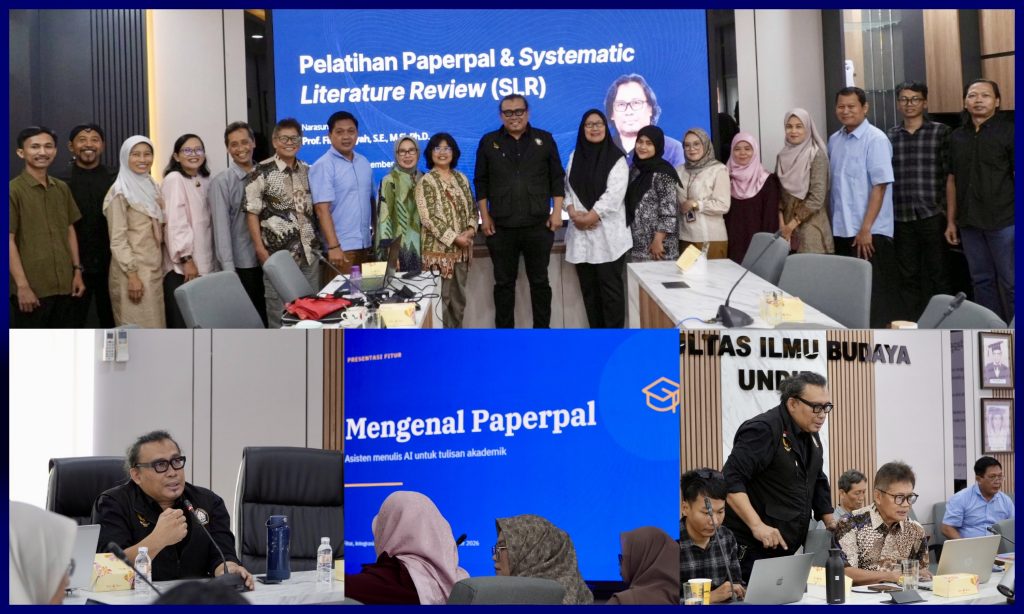
FIB UNDIP – The Faculty of Humanities at Diponegoro University (FIB Undip) continues to promote the improvement of the quality of scholarly writing among its faculty members.
On Wednesday (November 18, 2026), FIB Undip held a training session on Paperpal and Systematic Literature Review (SLR) in the Main Meeting Room on the second floor of the FIB Undip building in Tembalang.
This academic capacity-building initiative was attended by faculty members from across the Faculty of Humanities at Diponegoro University.
Opened by Faculty Leadership
The event was officially opened by the Vice Dean for Academic and Student Affairs at FIB Undip, Eta Farmacelia Nurulhady, S.S., M.Hum., M.A., Ph.D. Also in attendance was the Vice Dean for Resources at FIB Undip, Dr. Dra. Siti Maziyah, M.Hum.
Through this training, the faculty aims to familiarize its lecturers with modern research support tools while deepening their understanding of structured literature review methods to facilitate publication in reputable journals.
In-depth Exploration of SLR Methods and the Use of Paperpal
The core session featured Prof. Firmansyah, S.E., M.Si. Ph.D., as the guest speaker. During his presentation, he outlined the systematic steps for conducting a Systematic Literature Review (SLR) from formulating research questions and selecting relevant journal references to mapping out research findings in a coherent manner.
In addition to the SLR methodology, the lecturers were introduced to Paperpal, a tool designed to assist in the editing of academic manuscripts in English and had the opportunity to practice using it firsthand. This tool assists in checking grammar, academic writing style, and the overall readiness of article drafts before they are submitted to target journals.
Boosting Research Productivity at the “Campus of Culture”
The training session was highly interactive, featuring discussions and a Q&A segment focused on the common challenges lecturers face when writing scientific articles.
Through this training, faculty members at the “Campus of Culture” are expected to be better supported in accelerating the preparation of academic manuscripts, ultimately leading to a greater number of high-quality scientific publications.